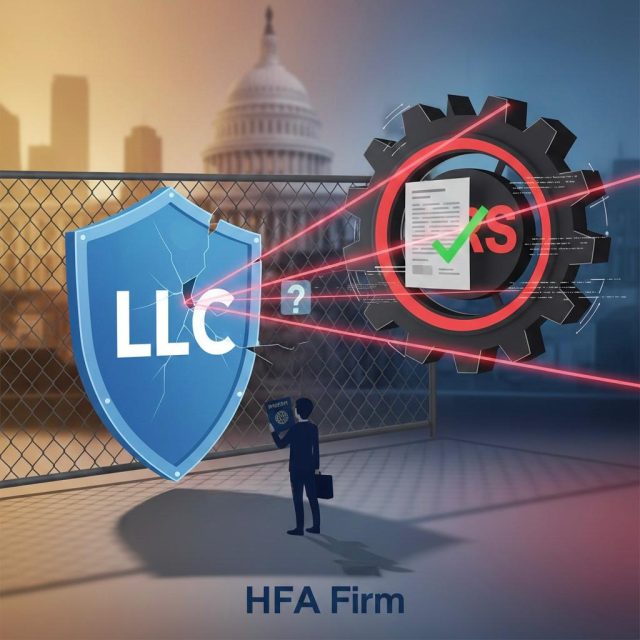
In recent years, LLC companies have become a popular choice among foreign entrepreneurs seeking to establish businesses in the United States. This is largely due to the legal flexibility and attractive tax advantages a Limited Liability Company (LLC) offers. However, this perceived safety has recently been questioned following significant updates issued by the IRS, which have fundamentally changed how foreign-owned companies are monitored even when there is no business activity or income.
So, are LLC companies still a safe option after increased scrutiny from the IRS?
And what should foreign owners understand today to avoid penalties and unexpected risks?
In this article, we provide a clear and simplified explanation of the most important updates, what has changed, what remains safe, and how you can protect your LLC from common compliance mistakes.
Have IRS Updates Changed the Status of LLC Companies?
Yes, the situation of LLC companies has changed in terms of compliance requirements — but not in terms of the legal structure itself. A Limited Liability Company remains one of the most flexible and attractive legal entities, especially for foreign entrepreneurs. The real shift came from the IRS, which has significantly tightened reporting and transparency requirements in recent years, particularly for foreign-owned entities.
In other words, LLC companies are no longer evaluated solely based on whether they generate income or conduct business in the United States. Instead, the IRS now places strong emphasis on proper reporting and timely filing. As a result, many companies that were previously considered “safe” are now facing penalties and risks simply due to non-compliance — even if the LLC has no revenue or active operations.
Are LLC Companies Still Safe for Foreigners After IRS Enforcement?
Yes, a Limited Liability Company (LLC) can still be a safe and suitable option for foreigners — provided there is a clear understanding of IRS compliance obligations. The recent enforcement does not mean that LLC companies are illegal or inherently risky. Rather, it means that managing an LLCnow requires greater awareness and consistent compliance with tax reporting rules.
The Internal Revenue Service (IRS) aims to increase transparency and regulate the relationship between foreign owners and their companies, not to prevent foreigners from forming a Limited Liability Company. Therefore, safety still exists, but it is no longer automatic — it depends entirely on proper filings and up-to-date reporting.
When Do LLC Companies Become Unsafe After IRS Updates?
LLC companies become risky when they fail to meet basic IRS filing requirements — most importantly, submitting Form 1120 and Form 5472 on time. Missing these forms is not considered a minor administrative delay; it is treated as a serious tax violation that may result in substantial penalties.
The real danger lies in the fact that many business owners are unaware that failing to file Form 5472, or failing to attach it correctly to Form 1120, can strip an LLC of its compliance protection — even if the company has no income. This makes proper filing of Form 1120 and Form 5472 a critical factor in maintaining the safety of LLC companies after recent IRS updates.
How Can HFA Firm Support LLC Owners with IRS Requirements?
At HFA Firm, we help LLC owners — especially foreign entrepreneurs — understand IRS requirements and manage them with clarity and confidence. Our approach focuses on practical, experience-based tax solutions while simplifying complex regulations into actionable steps.
Our professional support includes:
• Explaining tax obligations based on each LLC’s specific situation
• Helping avoid common compliance mistakes that lead to penalties
• Guiding business owners toward best practices for IRS compliance
• Providing initial consultations to assess current tax exposure and make informed decisions

Contact us today for an initial consultation to understand your tax position with confidence.
What Is the Relationship Between IRS Updates and Form 5472?
Recent IRS updates are directly linked to stricter enforcement of Form 5472 filing requirements for foreign-owned LLC companies. These updates focus on enhancing tax transparency and ensuring full disclosure of financial relationships between the company and its foreign owner — even if there is no activity or profit.
Form 5472 is the primary tool used by the IRS to monitor reportable transactions, such as capital contributions or expenses paid by the owner on behalf of the LLC. With increased enforcement, failing to file Form 5472, or filing it incorrectly, has become one of the leading causes of significant penalties — making it a core element in assessing whether an LLC remains safe after IRS updates.
Are Penalties the Real Risk After IRS Updates?
Penalties are not the only risk — but they are among the most serious consequences faced by a Limited Liability Company that fails to comply with IRS requirements. The issue goes beyond financial fines; repeated violations may cause an LLC to be classified as non-compliant, negatively affecting its legal standing and long-term viability.
A non-compliant LLC may face difficulties with banking relationships, expansion plans, or future restructuring. Therefore, the real risk lies not only in penalties but in the long-term impact on the company’s stability and legal safety after IRS updates.
What Happens If IRS Notices Are Ignored?
Ignoring correspondence from the IRS is one of the most serious mistakes any company can make — especially foreign-owned LLC companies. These notices are typically issued due to missing filings, requests for clarification, or warnings of potential violations that must be addressed within a specific timeframe.
When IRS notices are ignored, penalties often escalate and minor issues can turn into major legal problems. In some cases, additional fines may be imposed or the LLC may be flagged as non-compliant, affecting its ability to operate normally.
For this reason, timely and proactive communication with the Internal Revenue Service (IRS) is essential to maintaining the safety and compliance of any LLC.
Frequently Asked Questions
Do IRS requirements vary depending on the state where an LLC is registered?
Federal IRS requirements are consistent across the United States, but state-level administrative or tax obligations may vary depending on where the LLC is registered.
Can previous tax mistakes for an LLC be corrected?
Yes, in many cases errors can be corrected or late filings submitted, but early action is recommended to minimize penalties.
Do IRS updates affect forming new LLC companies?
IRS updates do not prevent forming new LLC companies, but they require clearer compliance from the first year, making advance planning essential.
Can closing an LLC eliminate IRS obligations?
Closing an LLC does not eliminate past IRS obligations; unresolved requirements may remain until properly settled.
Do foreign-owned LLC companies have different IRS obligations than local companies?
Yes, foreign-owned LLC companies are subject to additional reporting requirements aimed at increasing transparency even without income.
___________________________________________________________________________________________________________________________________
You also may be interested

What Does Establishing an Offshore Company Mean, and Why Might It Be the Right Choice for You?
How to Legally Dissolve a U.S. Limited Liability Company (LLC)? 4 Practical and Effective Steps