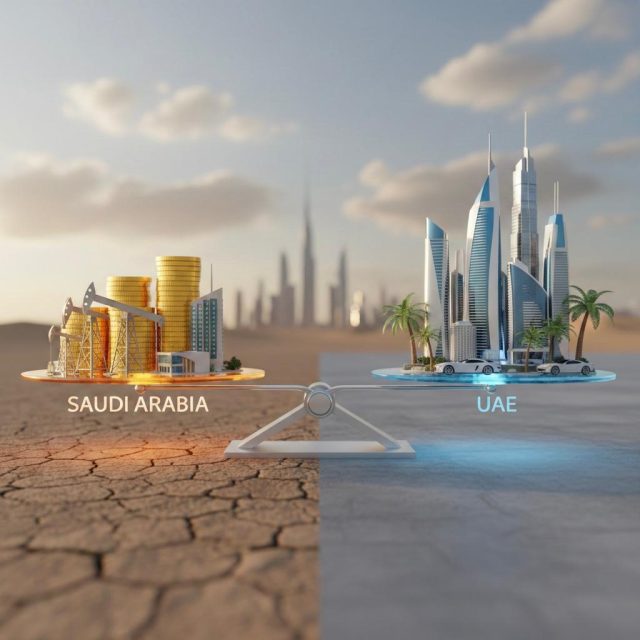
Imagine standing today in front of a decision that could shape the entire future of your business: should you proceed with Company Formation in Saudi Arabia or opt for Company Formation in the UAE?
On the surface, starting a company may seem like a legal or administrative step. In reality, it is a strategic decision tied to market size, growth speed, costs, and even opportunities that may not come twice.
Many entrepreneurs are drawn to the polished image of each market, but only a few truly understand when each country becomes the smarter choice — not just the more popular one. In this article, we go beyond traditional comparisons to reveal the angles that can completely reshape your decision and perhaps make you see the market you once overlooked as your biggest opportunity.
Keep reading — because the right choice here doesn’t just influence your start, but how fast you reach success.
Overview of the Investment Landscape
When considering Company Formation in the Gulf, the choice often comes down to Saudi Arabia and the United Arab Emirates (UAE), as they represent the region’s two largest and most attractive business ecosystems.
In Saudi Arabia, the investment scene is driven by a deep economic transformation focused on diversification beyond oil. This shift has created strong demand across sectors such as technology, tourism, and services. Companies targeting the local market or relying on large customer volumes often find a powerful growth environment, as the market is vast and still underpenetrated in many industries.
In contrast, the strength of the United Arab Emirates (UAE) lies in its role as a regional and global business hub. The Business Environment in the UAE is built on openness, financial mobility, and world-class infrastructure, making it ideal for companies operating across borders or relying on international trade and services. Many businesses use the UAE as a regional launchpad even when the local market isn’t their primary target.
In essence, the real difference isn’t which country is universally “better,” but which aligns more closely with your business model. If your success depends on domestic demand and internal growth, the scale tilts toward Saudi Arabia. If operational flexibility and rapid access to global markets matter more, the UAE offers a clear competitive edge.
Market Size and Demand
From a pure growth perspective, Company Formation in Saudi Arabia provides a clear advantage for businesses whose models depend on customer volume and local demand. The large population enables faster market penetration and gradual expansion within the same country without immediate regional scaling.
Meanwhile, Company Formation in the UAE tends to be more attractive for businesses designed to launch quickly and expand internationally, as the ecosystem supports companies targeting regional or global markets rather than relying solely on domestic demand.
In other words, the difference isn’t market strength — it’s the source of growth: internally driven in Saudi Arabia versus expansion-driven in the UAE.
Costs Comparison
When planning financially, it’s important to understand that the Cost of Company Formation in Saudi Arabia varies by activity and license type. In realistic averages, government fees and registration typically start around SAR 20,000–30,000 (approximately USD 5,300–8,000), with total setup costs reaching SAR 40,000–75,000 (USD 10,500–20,000) once legal services, address, and initial operational requirements are included — especially when Opening a Company in Saudi Arabia for Foreigners, where investment licensing fees apply.
In comparison, Investment in the UAE shows more variation depending on jurisdiction. In free zones, businesses can often start within AED 15,000–35,000 (USD 4,000–9,500), while mainland setups typically range between AED 40,000–90,000 (USD 11,000–24,500) when factoring in licensing, office space, and services.
The accurate conclusion is that the cost gap is not as large as commonly assumed. Saudi Arabia may be slightly higher initially but becomes more cost-efficient when leveraging its market scale, whereas the UAE offers a flexible entry point, especially for businesses testing markets or operating regionally.
Tax Environment
Looking at Corporate Taxes in Saudi Arabia, foreign-owned companies are generally subject to a 20% corporate income tax, while Gulf-owned entities usually pay Zakat instead. This creates a clear tax obligation, balanced by access to a large and growing market.
By contrast, the Business Environment in the UAE reflects a low-tax approach, with a federal corporate tax of 9% applied to profits above a certain threshold, alongside potential incentives or exemptions in some free zones depending on compliance and activity.
When Saudi Arabia Is the Smarter Choice
Company Formation in Saudi Arabia becomes the most logical option when your business success depends on the domestic market — particularly customer-driven models, local contracts, or participation in major national projects. Being physically present in the market provides a tangible competitive advantage through proximity to clients and deeper demand insights.
It is also the smarter move for long-term growth strategies rather than market testing, as regulatory frameworks and incentives are designed to attract companies committed to expanding within the economy.
Choosing the Best Country to Start a Business in the Gulf often depends on strategic alignment, and expert guidance can significantly reduce time and legal risks, especially for foreign investors.
When the UAE Remains the Better Option
The UAE continues to be the optimal choice when speed, flexibility, and international reach are critical. Companies targeting external markets or relying on cross-border trade benefit greatly from the Business Environment in the UAE, which supports rapid setup, capital mobility, and efficient regulation.
Additionally, Opening a Company in the UAE for Foreigners offers clear advantages such as foreign ownership options and free zone structures that simplify early-stage operations.
In short, the UAE excels when global access and operational agility outweigh reliance on domestic demand.
High-Growth Sectors in Saudi Arabia
Several industries currently stand out due to strong investment momentum and rising demand:
• Technology and digital transformation
• Tourism and hospitality
• Logistics and supply chains
• Entertainment and creative industries
These sectors attract investors because they combine strong demand with government support, making them a common starting point for market entry strategies.
How to Choose the Right Country Based on Your Business Model
Choosing the right country is not about a single factor such as costs or taxes, but about a clear understanding of your business activity, where your customers are, and how you plan to scale. Companies that rely on strong local demand often benefit from larger domestic markets, while those that require operational flexibility or international positioning may gain more from globally connected ecosystems.
This is where strategic insight becomes essential. The right decision isn’t generic — it should be built around your specific business model, growth expectations, and operational priorities.
At HFA, we help you evaluate these factors from a practical, data-driven perspective to identify the most suitable market, then support you through every stage of company formation and implementation.
To date, we have helped establish more than 1,000 successful companies, backed by over 7 years of hands-on experience across Gulf markets. This gives us a real understanding of on-the-ground challenges and opportunities — not just theoretical advice.

FAQs
How long does it take to set up a company in each country?
In the UAE, the process is often faster (from a few days to a few weeks), while in Saudi Arabia it can take several weeks or longer depending on approvals and activity.
Can foreigners fully own companies in both countries?
Yes. Full ownership is now possible in many sectors in Saudi Arabia and widely available in the UAE, particularly in free zones.
Which country is better for startups?
Startups targeting large domestic demand or government-backed sectors may prefer Saudi Arabia, while those seeking global exposure and easier funding often choose the UAE.
Can a company relocate from the UAE to Saudi Arabia later?
Yes, through restructuring or establishing a new entity and gradually transferring operations, though it requires legal and financial planning.
________________________________________________________________________________________________________________________________________
You may also be interested in

70% Localization of Procurement Jobs in Saudi Arabia: Objectives and Impact on the Labor Market
How a Foreign Entrepreneur Can Obtain the Entrepreneurship License in Saudi Arabia in 2025