

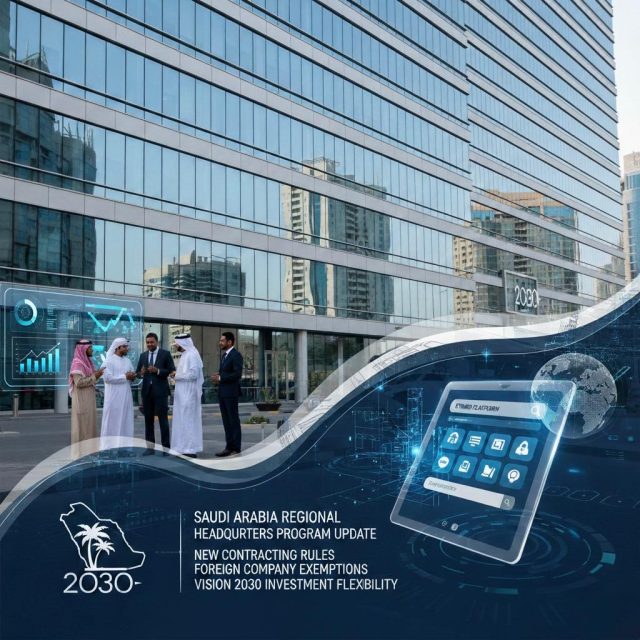
In a step reflecting the regulatory flexibility adopted by the Kingdom to accelerate economic transformation, major updates have recently been announced granting government entities broader authority to contract with global companies. This development comes to organize the framework of Regional Headquarters (RHQ) in Saudi Arabia, as the new amendments aim to balance national ambitions for business localization with the practical needs of mega-projects that require specialized international expertise.
This new phase not only enhances government spending efficiency but also opens broader horizons for investors to understand the competitive landscape under the Kingdom’s ambitious vision.
What Are the Latest Amendments to the Regional Headquarters Regulations?
The business environment has recently witnessed a notable strategic shift through the Amendments to the Regional Headquarters Regulations (2024–2026). The Kingdom introduced new flexibility allowing government entities to contract with global companies that have not yet established their headquarters in Riyadh, subject to specific controls that ensure the continued flow of specialized expertise for major projects.
This step does not represent a retreat from ambitious goals; rather, it is a pragmatic regulation that strengthens the effectiveness of the Regional Headquarters (RHQ) in Saudi Arabia program by granting exemptions in cases of technical scarcity or strong price competitiveness.
These amendments aim to ensure the Kingdom remains an attractive destination for business while maintaining the pace of strategic project delivery without procedural obstacles, balancing localization objectives with fast-moving market needs.
How Does Saudi Vision 2030 Support Flexibility for Foreign Companies?
These amendments are an integral part of Saudi Vision 2030, which aims to transform the Kingdom into a global logistics and commercial hub. While the strategic objective remains to encourage high-quality investment and knowledge localization, the vision recognizes that flexibility is key to success in a changing global economy.
Allowing Foreign Companies in Saudi Arabia to participate in major projects — even without a regional headquarters — ensures that opportunities to leverage innovation and rare global expertise are not missed, accelerating the achievement of national transformation goals.
This flexibility reflects the maturity of the regulatory environment, creating a careful balance between supporting local labor market growth and keeping the doors open to world-class capabilities and technologies required for giga-projects such as NEOM and the Red Sea.
What are the rules for Contracting with Companies Without a Regional Headquarters
Regulatory authorities have established a precise framework clarifying the Rules for Contracting with Companies Without a Regional Headquarters to ensure transparency and fair competition. These rules do not eliminate priority for local companies or those with a regional headquarters but create a legal window to contract with global expertise in clearly defined exceptional cases.
The Requirements for Foreign Companies to Participate in Government Projects (without an RHQ) fall under two main scenarios:
- Technical Exclusivity
If the government entity determines that the foreign company is the only provider with the required technical solution or specialized expertise, with no equivalent local or regional competitor.
- Significant Price Superiority
Contracting is permitted if the foreign company’s proposal is technically compliant and offers substantial economic savings — at least 25% lower than the second-best offer from a company with a regional headquarters in the Kingdom.
Through this mechanism, the government secures the highest quality at the best price while maintaining the attractiveness of the RHQ program as a long-term strategic option.
What are the requirements for Foreign Companies in Saudi Government Tenders
Participation of global companies in Saudi Government Tenders is governed by a precise regulatory framework that prioritizes companies with a regional headquarters in the Kingdom. However, the new amendments include clear conditions allowing other foreign companies to compete under specific circumstances.
The most important requirement is that the government entity must submit a prior exemption request through the Regional Headquarters Registration Platform (Etimad Platform), where the foreign bid is evaluated based on strict criteria — including the absence of a local or regional alternative with the same technical quality or the presence of an exceptional price advantage (25% difference).
This system ensures that tenders remain a fair competitive arena serving the national economy while maintaining transparency and digital governance standards.
How to Submit Exemption Requests via the Regional Headquarters Registration Platform ?
The exemption request process is fully digital to ensure governance and speed, aligned with the New Government Procurement Law. Key procedural steps include:
- Identify the Need for Exemption
The government entity studies the market to confirm technical exclusivity or major price advantage.
- Access the Etimad Portal
The request is submitted through the dedicated section of the platform before tendering or direct contracting.
- Attach Technical & Financial Justifications
Documents must demonstrate the absence of an equivalent local alternative or confirm the 25% price advantage.
- Review & Decision
A specialized committee reviews the request and issues an exemption number if approved, allowing contract award.
Wich contracts are Automatically Exempted Under the New Government Procurement Law?
To support SMEs and ensure operational flexibility, the New Government Procurement Law sets a financial threshold for automatic exemption from RHQ restrictions.
Contracts with an estimated value below SAR 1 million do not require prior exemption when contracting with foreign companies without an RHQ.
This automatic exemption aims to:
• Support supply chains
• Reduce bureaucracy
• Enable smaller and foreign companies to enter the Saudi market
Thus, the system balances strictness in mega-projects with flexibility in smaller operational contracts.
When Is Establishing a Regional Headquarters the Best Option?
Despite exemptions, establishing a Regional Headquarters (RHQ) in Saudi Arabia remains the golden key to sustainable mega-projects.

Start your real expansion journey in the heart of the Kingdom with HFA Firm — contact us to book your consultation with our specialized team.
FAQ
Do the new exemptions cancel the RHQ tax incentives?
No. Tax exemptions (up to 30 years) apply only to companies that establish an actual RHQ in the Kingdom.
Do exemption rules apply to consulting contracts?
Yes, they apply to all government contracts, particularly advisory services requiring rare expertise.
What about foreign companies with local branches?
Branches are not treated as RHQs in major tenders and must also request exemptions via the platform.
Can a company operate permanently under an exemption?
No. Exemptions are typically project-specific; establishing an RHQ remains the most reliable long-term strategy.
Do these rules affect private-sector contracts?
No. They apply only to government entities and state-controlled institutions; private companies remain free to contract without RHQ requirements.
____________________________________________________________________________________________________________________________________
You may also be interested in

Investment in Saudi Arabia 2026: Historic Reforms Open the Market to Foreign Investors
70% Localization of Procurement Jobs in Saudi Arabia: Objectives and Impact on the Labor Market